Ninety seconds left on the platter, someone talking in your ear, fingers flicking through sleeves. What saves you isn’t a setlist. It’s how you packed.
The 7 ways at a glance
1. Pack a bag, not a setlist
Your plan is the order of the bag. Warm-up at the front, then mid-tempo, floor fillers and closers, with a few rescue records at the back for when the room turns on you. Dividers help you find your place in a dark booth.
2. Leave key off the sleeve: 6% pitch is a semitone
The pitch fader speeds up the whole record, so key moves with tempo. Push it 6% and the track sits a full semitone higher. The key on your sleeve is wrong the moment you ride the pitch.
A 124 BPM record at common pitch settings.
| Pitch | BPM | Key moves |
|---|---|---|
| −8% | 114.1 | 1.4 down |
| 0% | 124.0 | no change |
| +3% | 127.7 | 0.5 up |
| +6% | 131.4 | 1.0 up |
| +8% | 133.9 | 1.3 up |
CDJs have key lock; turntables don’t. And Camelot codes from key software are wrong more often than you’d think. On vinyl, your ears do the key work.
3. Bring about twice what you’ll play
Two choices for every slot. At a record every four minutes, an hour is 15 records played, so pack 30. Records with two good sides stretch further. The ones you can’t replace ride in your hand luggage.
4. Keep blend pairs together
File records you know blend side by side, and note the pitch change each pair needs. When the floor stalls, a run you trust is one flick away.
5. Label the top edge, not the art
Ask on any vinyl DJ forum and you’ll hear the same trick: put labels on the clear outer sleeve, up by the top edge, so you read them without pulling the record. Keep each one to what you use mid-mix: side, BPM, energy, and one note, like the intro length or whether it fades or ends cold. Add the title too: sleeves get swapped at gigs.

Prefer colour? Give each BPM range its own dot colour, and put a dot on the centre label to mark the side you play.
6. Let Teca work out the BPM
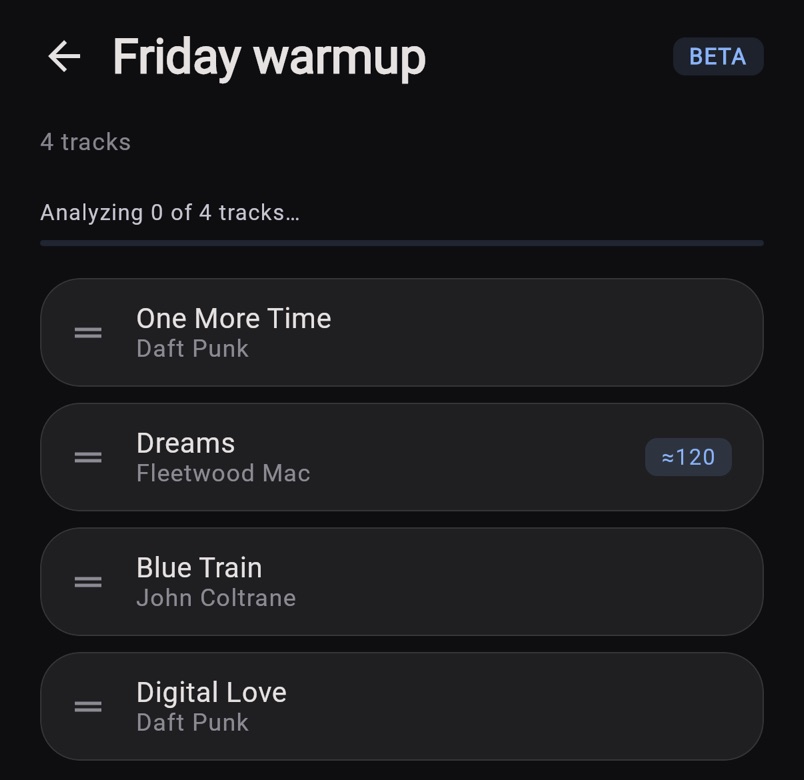
Labelling a thousand records by hand is where most DJs give up. Add records to a setlist in Teca and it estimates each track’s BPM for you, marked ≈, so your labels start from a number instead of a stopwatch.
7. Decide live, by ear
The bag is a map, not a script. Take the request, jump to the back of the bag when the warm-up runs hot, and when a blend clashes, cut the next record in. That part no prep can do for you.
Labels that won’t wreck your sleeves
- Avery removable colour dots, ¾"One colour per BPM range. Peels off clean.
- Avery removable 2×4" labelsThe Avery 5263 size, but removable. Write or print full labels.
- ChromaLabel 2×3" writable labelsEasy to write on with a marker. Permanent glue: outer sleeve only.
- Clear resealable outer sleevesSomewhere to stick the label that isn’t the jacket.
Coming soon to Teca
Key, BPM, energy and fit, in your vinyl setlist.
Teca’s vinyl setlist maker will show each track’s key, BPM and energy level, how well it fits the track before it, and the transition between them. On your iPhone.
- Key≈ 8A
- BPM≈ 124
- Energy≈ 4 of 5
- Into next≈ Smooth
Free for the first 1,000 members. Estimates are marked ≈; key is at 0% pitch.
Vinyl set prep: questions and answers
How many records should I bring to a vinyl gig?
About twice what you’ll play: roughly 30 records for an hour, 60 for two.
Should I write the key on my records?
Only if you measured it and play near 0% pitch. A 6% pitch change moves a record about one semitone, so a written key goes stale as you ride the pitch.
What should go on a record label?
Side, BPM, energy and one note, such as intro length or a cold ending, plus the title in case sleeves get swapped. Put it on the outer sleeve near the top edge.
Written by the Teca team. Pack differently? Tell us.